

Why commercial-grade stability balls outperform everything else — and how to choose the right one for your body and training.
Made from low-grade, overly bouncy material — leading to awkward feel, poor control, and inconsistent inflation results.
Common in big gyms with top-end machines — but the worst quality balls.
- Unsafe under load — prone to rolling, sliding, or bursting
They’re unappealing, ineffective, and unreliable — and unfortunately, all too common in gyms and stores.
What I Use (and Sell): Commercial-Grade Stability Balls
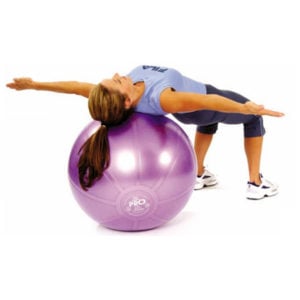
In my work as a postural and movement specialist, I only use professional-grade anti-burst balls — trusted by athletes, coaches, and performance specialists globally. They’re firm, durable, and built to perform — specifically made for weighted training. These aren’t toys — they’re tools.
Key Benefits:
- Holds shape under pressure – no collapsing, even during seated or loaded work
- Anti-burst construction – slow deflation if punctured, not an explosion
- True-to-size inflation – 55 cm, 65 cm, 75 cm — exactly as measured
- Safe for weighted training – ideal for bridging, pressing, and integrated strength
- Lasts years, not months – won’t sag, stretch, or deform with use
These are the only Swiss balls I trust in my studio — and the only ones I recommend to clients.

Who Are They For?
These aren’t just for core workouts or sitting at your desk (although they’re amazing for both). They’re ideal for:
- Postural and spinal alignment work
- Strength training on dynamic or unstable surfaces
- Stability and deep core control
- Safe, active sitting — for posture without a rigid chair
- Rehab, injury prevention, and performance training
If you’re serious about movement quality, posture, and long-term joint health, this is one of the most versatile tools you can own.
Which Size Should You Get?
Choosing the right size is key for comfort, control, and alignment:
- 55 cm – for heights 150–165 cm (4’11″–5’5″)
- 65 cm – for heights 166–180 cm (5’6″–5’11”)
- 75 cm – for heights 181–195 cm (5’11″–6’5″)
When sitting, your hips should be level with or slightly higher than your knees. If you’re between sizes, it’s not always best to size up — I often adjust the inflation level to suit individual needs. Many clients find the perfect fit by under- or over-inflating slightly based on their body proportions, posture goals, or workspace height.
The good news? These balls are versatile — and with some care in how you inflate, you can get the perfect setup for your body.
How to Inflate Your Ball Correctly
When your ball arrives, it may need a few inflations over 24–48 hours to reach full firmness. Here’s how to do it right:
- Use a hand or foot pump (most standard inflators will work). A compressor is even better for reaching full firmness efficiently.
- Inflate it to about 80% full and let it rest for 24 hours to allow the material to stretch.
- The next day, top it up to its full size:
55 cm, 65 cm, or 75 cm in height when standing upright on the floor. - The ball should feel firm to touch — not spongy — and hold its shape under bodyweight.
A measuring tape against the wall, or marking the correct height on the wall, helps you gauge full inflation.
What Clients Say
Clients regularly rave about the feel, stability, and firmness of these commercial-grade balls. They often say, “This feels completely different to the ones I’ve used before.” They immediately notice the difference — no sagging, no sliding, no collapsing under weight.
Many have said, “This is the first ball I’ve felt truly safe and supported on.” The quality is obvious the moment you sit, move, or train on it.
Many clients who’ve travelled globally say the same thing — they walk into hotel gyms or commercial facilities and find a deflated, poor-quality ball in the corner. They all agree: those are terrible to train on. Once you use a professional-grade Swiss ball, you won’t go back.
How to Order
I stock these — trusted by elite teams, movement professionals, and serious trainers.
- 55 cm – $155
- 65 cm – $165
- 75 cm – $175
Pick-up or delivery available. Order now at michelleowen.co.nz/shop
Final Word
If you’re working on posture, movement, or strength — or simply want to sit better at your desk — this is the tool I recommend to every client. It’s not just another exercise ball. It’s a training platform, a movement educator, and a structural support system. And yes — it’s worth it.
Also known as:
Swiss Ball · Stability Ball · Fit Ball · Physio Ball · Exercise Ball · Gym Ball · Anti-Burst Ball · Core Ball · DuraBall · Office Ball Chair · Posture Ball · Commercial-Grade Ball
Keywords for Search Engines:
Swiss ball, stability ball, anti-burst gym ball, best exercise ball for weight training, posture ball, desk chair ball, core stability tool, high quality exercise ball NZ
Written by Michelle Owen
Postural & Structural Specialist
www.michelleowen.co.nz
Have questions or want help choosing the right size? Contact me here, or order online at michelleowen.co.nz/shop


0 Comments